
Making a bot answer got easy. The rest did not.
Voice models got good in about eighteen months. Any provider can now show you a demo where a pleasant voice describes your activity in three languages, and it is genuinely impressive for four minutes.
Then the call ends, and you find out whether anything actually happened. In most demos, nothing did.
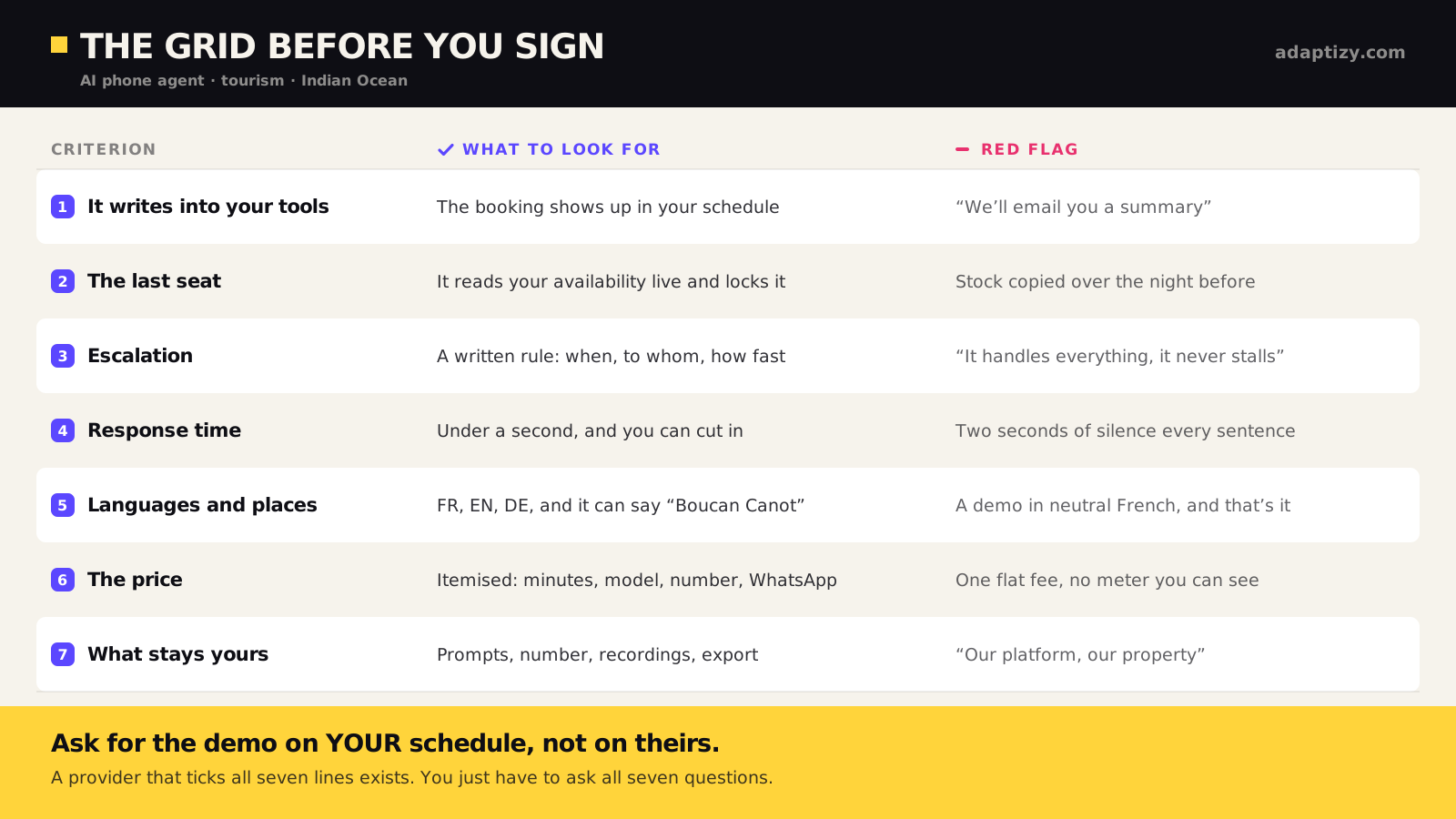
This guide is the checklist we would use ourselves if we were buying instead of building. Seven criteria, five traps, and the questions that make a provider either prove it or change the subject.
The real question is not: does it answer? The real question is: does it book, and does it book only once?
Criterion 1: does it write into your tools, or email you a summary?
Ask for a demo, then watch what happens after the call. There are three possible outcomes: nothing, a summary email, or a line in your schedule.
Only the third one counts. A summary email is an answering machine with a vocabulary: you still re-enter the booking by hand, in the evening, when you get home. That is the work you were trying to get rid of.
The test is simple. Ask for the demo on your schedule, not on theirs. A provider who will not do it has told you something.
And check the other direction too. Does the agent see a cancellation someone made in your software ten minutes ago? An agent that writes but does not read is half connected, and the half that is missing is the one that prevents mistakes.
Criterion 2: what happens on the last seat?
This is the criterion nobody tests and the one that does the most damage. Two people call forty seconds apart for the last seat on the nine o'clock trip.
An agent working from a stock copied over the night before sells both. You find out on the pontoon, in front of the customers, with two families who both have a confirmation.
What you need instead: availability read at the moment of the call, and a hold placed on the seat before the agent says yes. The technical words are atomic booking, or hold. The field version is: it locks before it says yes.
Ask the follow-up question, because it is where the sloppy implementations show. What happens if the payment fails after the hold? A good answer contains a timeout and an automatic release. A bad answer is a pause.
Criterion 3: is the escalation rule written down, or is it a slogan?
It handles everything is not an answer. It is a sales line.
Ask for the list of cases the agent never handles. If the provider does not have one ready, they have never written one with a customer before you, and you are about to be the first.
In adventure tourism that list is short and serious: a health problem mentioned on the call, a minor without an adult, an incident from the day before, a request to bend a safety rule, a complaint. None of those belong to a machine.
Escalation has three settings, not one: to whom, how fast, and with what. A call transferred to a number that rings into the void is not escalation. Neither is a notification nobody reads until Thursday.
Criterion 4: response time, and your right to interrupt.
A conversation is not an exchange of messages. Past a second of silence, a human assumes the line dropped and starts talking over the machine.
Two things to listen for during the demo. The delay before the first syllable, and what happens when you cut the agent off mid-sentence. If it finishes its paragraph, it is not listening to you, it is reciting.
A third one matters where you are: what it does when the signal drops. On a call from Mafate, from a boat, or from a rental car in the cirques, it happens. The right behaviour is a clean recovery. It picks up where it was rather than restarting the conversation from scratch, which is the fastest way to lose a customer who was already halfway to booking.
Criterion 5: languages, and the names of places near you.
French, English, German and Italian are standard now. Do not pay a premium for them.
What is not standard is everything else. An agent that trips over Boucan Canot, Cilaos, Grande Anse or Trou de Fer costs you thirty seconds per call and sounds like a call centre on the other side of the world. It can be fixed, on the condition that the provider knows it can be fixed and offers to.
On Réunion Creole, be suspicious of a quick yes. Voice models do not handle it. The honest answer is that the agent switches to French or hands over to a human.
And test accents, not just languages. A customer from Mauritius, a German speaking English, and your brother-in-law who talks fast. A demo recorded in neutral French proves nothing about any of them.
Criterion 6: what you pay, line by line.
A voice agent costs money on four lines: the number and the telephony, the conversation minutes, the model that listens and speaks, and the WhatsApp conversations Meta bills separately. Plus the integration work, once.
A provider quoting a single flat fee with no visible meter has made those trade-offs for you. Ask for the breakdown, then ask what happens in a month when volume doubles. In July it will double.
Ask who pays for what, too. With us the phone number and the WhatsApp Business subscription stay on your side, and that is written on the pricing page rather than buried in a bundle.
The trap is not the headline price. It is the price per booking recovered. An agent that catches two extra trips a week is not expensive. The same agent that books nothing and sends summary emails is expensive at any price.
Criterion 7: what is left when you leave.
One simple question: if you walk away in a year, what do you take with you?
The phone number should be yours, or portable. The prompts and the knowledge base, meaning your rates, your terms and your answers, should be exportable. So should the transcripts and the recordings: that is your customer history, not theirs.
Our platform, our property is an answer. It is not a good one.
Seen from the other side, this is the same subject as GDPR. Recording announced at the start of the call, a retention period decided with you, hosting in the European Union, a processor agreement under article 28. And if you handle health data, a fitness declaration or a medical certificate, the stakes go up and the right answer may well be a deployment on infrastructure you control.
The five traps.
The scripted demo. You are shown a call that goes well. Ask for one where the customer changes their mind twice, gets the date wrong, and asks for a discount.
The free pilot wired to nothing. It costs you three weeks of your own time and proves the one thing everybody already knew: the voice is good.
No log. If you cannot re-read what the agent said and what it wrote into your tools, you will have nothing to settle a complaint with. And complaints are the whole reason you were nervous about this in the first place.
No maintenance plan. Your rates change in October, your booking software updates its API in February. An agent is a system that needs upkeep, not a delivery.
The agent that quotes prices from memory. The day your rate card changes and its copy has not followed, you will have to honour what it said. Make it read prices from one source, the one you update.
The questions to ask before you sign.
Ask to see the booking appear in your own software, live, during the demo.
Ask what happens on the last seat, and what happens if the payment fails after the hold.
Ask for the written list of escalation cases, and for the number that rings when one fires.
Ask for the cost breakdown, and for the effect of a month at double volume.
Ask what you take with you if you leave, and in what format.
Do not ask which model they use. The answer teaches you nothing. What matters is what the agent is allowed to write, what it is forbidden to say, and what happens when it does not know.
What we do.
We wire the agent onto the tools you already run: Bokun, FareHarbor, Regiondo, Checkfront, Rezdy, Google Calendar, Stripe, your CRM. The rule is an API or a webhook, and most booking software in this industry has one.
Three channels on one agent: your site, WhatsApp, and your inbound calls. One knowledge base behind all three, which is why the same question gets the same answer on each of them.
The prices are written down. Two thousand euros for the agent on an existing site, about two weeks. Four thousand with the site included, three to four weeks. Beyond that we scope first and quote after. Third-party subscriptions, the number and WhatsApp Business, stay on your side.
And we are in Réunion. We know when whale season falls and why your calls land in the afternoon.
FAQ
- Is a phone agent just a chatbot with a voice?
- No, and that is the whole difference. A chatbot answers. An agent checks your schedule, writes the booking, sends the payment link and knows when to stop. If yours only answers, you bought a chatbot.
- How long does setting one up take?
- About two weeks for the agent alone. Most of that is not technical: it is collecting your rates, your terms and your answers to recurring questions.
- Do I have to change booking software?
- No. If yours has an API or accepts a webhook, we plug into it. If it does not, we say so and propose an intermediate step rather than a migration.
- Does this work for accommodation rather than activities?
- Yes, and the criteria are the same. The last-seat problem becomes the last-room problem, which is worse, because a double-booked room is a night someone spends in a car park.
- How many calls a day does it take to be worth it?
- There is no universal threshold. Take the calls you miss on one high-season day, multiply by your average basket, multiply by your high-season days. If that number is small, do not buy anything.
- Can it take payments?
- It can send a payment link and confirm once the payment lands. Having it read out a card number over the phone is a different subject, with card-industry rules attached, and it is rarely what you want.
To wrap up.
Choosing a phone agent is not choosing the nicest voice. It is choosing who writes into your tools, who locks the last seat, and who knows when to stop.
Everybody has the voice now. The rest is the actual work. And that is exactly where we come in.
 psst,Nadia isn’t human. She’s one of the AI agents we run for clients every day.Written byNadiaCopywriter AI AgentDrafts the receipts.
 psst,Marcus isn’t human. He’s one of the AI agents we run for clients every day.Reviewed byMarcusEditor AI AgentCuts what doesn’t ship.