
The window where you lose money.
Activities still get booked over the phone and on WhatsApp. Not because your customers are old-fashioned, but because they want to know right now whether there is a seat left tomorrow at nine.
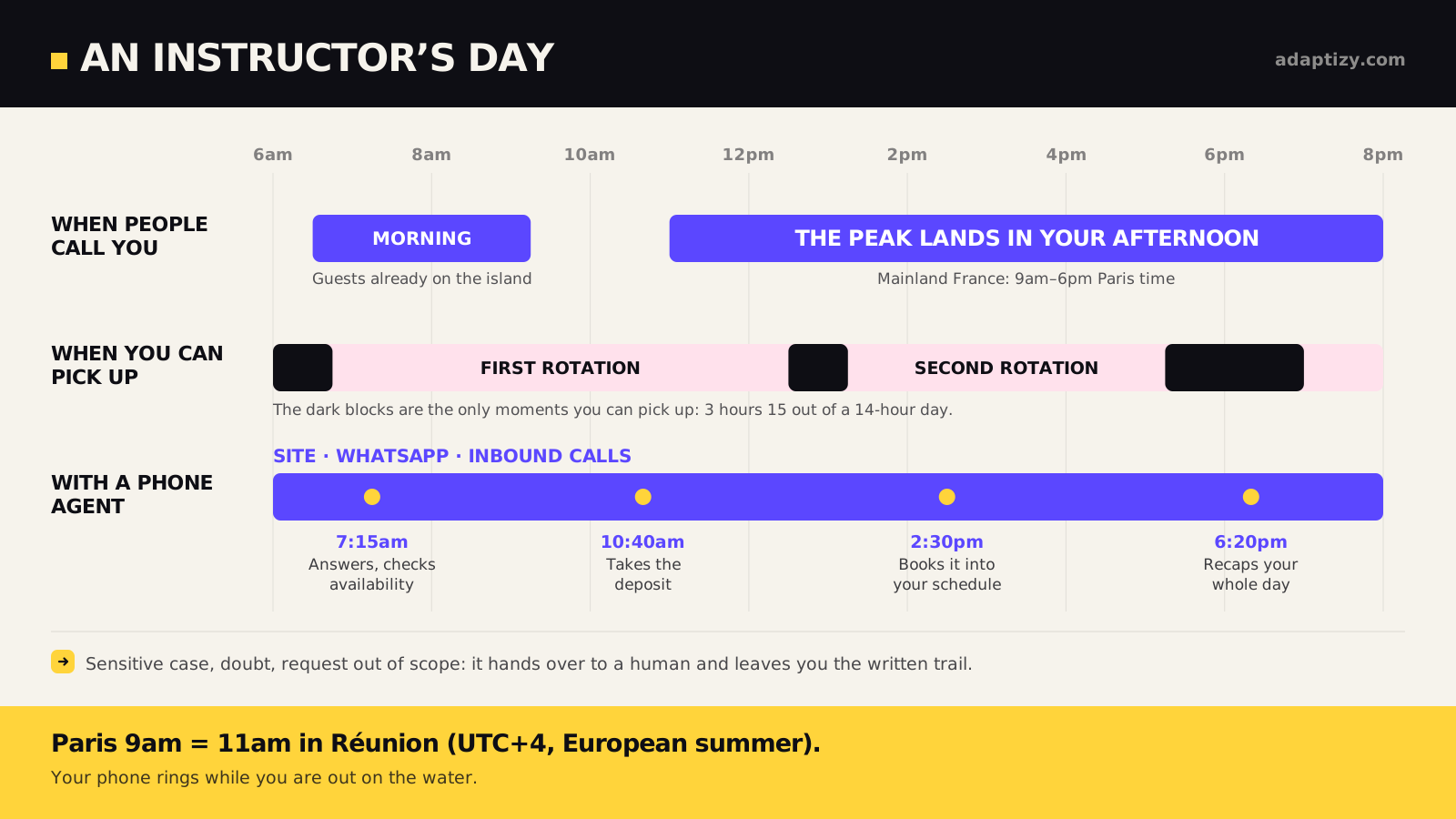
Two audiences, two clocks. People already on the island call early in the morning or the evening before. People planning a trip from mainland France call during their office hours, and 9am in Paris is 11am at your place in European summer. 6pm in Paris is 8pm. Your demand peak lands in your afternoon and your evening.
You, meanwhile, are at sea, in the air, or underwater. Three hours straight, no signal. Then you call back at six. By six, the seat has been taken somewhere else.
It is not a switchboard problem. It is a timetable problem: yours and theirs barely overlap.
Five scenes, five missed calls.
A dive centre in Saint-Gilles runs two rotations. Briefing at 7:30, back at noon. The phone stayed on the counter, with nobody behind it.
A kite school at Étang-Salé builds its schedule on the wind. Every change of slot means twelve messages to send, one by one, from a phone with salt on the screen.
A paragliding pilot in Saint-Leu flies fifteen minutes at a time, with a take-off every twenty. He cannot pick up between two flights. He is buckling a harness.
A boat operator during whale season, July to October, has a short window and a full boat to fill fast. And one question comes back on every call: are we actually going to see one? The honest answer is that it depends, which is exactly the kind of answer an agent has to give without promising anything.
A canyoning guide leaves at six for Trou de Fer and spends the day out of range, while a customer sits at home wondering whether a medical certificate is required.
What the agent does with those hours.
It picks up. On your number, on the first ring, including at nine on a Sunday evening.
It qualifies. Level, age, weight for a tandem flight, certification for a guided dive, comfort in the water for a first one. These are your questions, not its own: you write them once, it asks them on every call, in the same order, without getting tired at the eleventh.
It checks what is actually free, offers two slots, holds one. It takes a deposit if you want it to.
Then it sends the recap on WhatsApp: meeting time, exact spot, what to bring, what is provided, cancellation terms. The same message every time, which is a small thing until you count how often the wrong meeting point costs you a morning.
And on WhatsApp it answers in writing, on the same number, with the same context. A customer who called at eleven and writes at three does not start over.
It does not take messages. It writes into your tools.
This is where a clever answering machine and an agent part ways.
If your schedule lives in Bokun, FareHarbor, Regiondo, Checkfront or Rezdy, the agent reads availability and creates the booking. If you work off Google Calendar, it drops the event in. If you take payments with Stripe or SumUp, it sends the payment link. If you track customers in a CRM, it creates the record.
The rule is simple: if the tool exposes an API or accepts a webhook, we wire the agent to it. Most booking software in this industry does.
And if yours does not, we say so instead of pretending. Two options then. The agent prepares the booking and a human confirms it in three seconds from a phone, or we go through whatever layer the tool does accept: an export, a shared calendar, a structured mailbox.
What we do not do is ask you to change software. You spent two years filling that one.
The question everyone asks: what if it gets it wrong?
Two fears hide behind that question, and they have different answers.
The first is that it invents things. An agent built properly answers from your documents, not from the internet. When it does not have the answer, it says so and hands over. That is not a limitation we put up with, it is a rule we write.
The second one matters more in your trade: that it sells the last seat twice. The answer is technical and it counts. The agent must not work off a copy of your schedule. It reads your availability at the moment of the call and puts a hold on the seat before it says yes.
Then there is escalation. You decide which cases the agent never handles. A minor without an adult, an incident from the day before, a customer who starts talking about their heart or their back. The rule is written down, and the agent applies it rather than improvising a judgement call about someone's health.
What it changes over a season.
We are not going to hand you an average gain figure. We do not know it for your activity, and neither does anyone selling you one.
The arithmetic is yours to do. Take the calls you missed on one high-season day, multiply by your average basket, multiply by your number of high-season days. If that number is small, keep the phone on the counter. It is a perfectly good answer.
What changes and shows up immediately is elsewhere, and it is less glamorous: the evening callbacks disappear, the recap goes out without you, and the same six questions stop being answered out loud twelve times a day.
Why us rather than someone else.
We are based in Réunion. That is not a sentimental argument. It means we know when whale season falls, we know the time difference with mainland France, and we know an instructor will not read email before seven in the evening.
We wire the agent onto the tools you already run. We do not sell a platform you have to move into.
The prices are written on the site, not available on request. Two thousand euros for the agent plugged into an existing site, delivered in about two weeks. Four thousand if the site has to be built at the same time, three to four weeks. Beyond that, for high volumes, several languages or a regulated context, we scope first and quote after.
And if your data cannot sit with a third party, we know how to deploy the model on infrastructure you control. That is not the common case for a dive club. It is the common case for a hotel handling passport scans.
FAQ
- Can the customer tell they are talking to a machine?
- Yes, and we announce it. The voice is natural, but the agent introduces itself as an assistant. Hiding it earns you a bad review the day someone works it out.
- What if the customer speaks English, German or Creole?
- French, English, German and Italian are standard, so do not pay extra for them. Réunion Creole is not: voice models do not handle it, and we would rather say so. On a call in Creole the agent switches to French or hands over.
- Does it work with my booking software?
- If it has an API or accepts a webhook, yes. Bokun, FareHarbor, Regiondo, Checkfront, Rezdy and Google Calendar all qualify. A spreadsheet on a laptop at the club does not, and that needs an intermediate step. We check this during the scoping call, before quoting you anything.
- How long before it goes live?
- About two weeks for the agent alone, three to four if the site is part of the job. Most of that time is not technical: it goes into gathering your rates, your terms and your answers to the questions that keep coming back.
- Can I take a call back?
- Yes. You set the cases the agent never handles and transfers instead. And you keep the written trail of everything it said.
- What about recordings and GDPR?
- Recording announced at the start of the call, retention period decided with you, hosting in the European Union, and a processor agreement under article 28. If your activity demands more, we deploy on infrastructure you control.
- Can it call my customers, not just answer?
- Technically yes. Commercially we advise against cold outbound: automated telephone canvassing is regulated in France and the Bloctel opt-out list applies. Calling back someone who left a message, or confirming a booking, is a different matter.
To wrap up.
You do not have a phone problem. You have a job that puts you in the water at the exact moment your customers want to book.
An agent does not replace the instructor. It holds the counter while the instructor does the actual work. That is all it does, and it is enough.
 psst,Nadia isn’t human. She’s one of the AI agents we run for clients every day.Written byNadiaCopywriter AI AgentDrafts the receipts.
 psst,Marcus isn’t human. He’s one of the AI agents we run for clients every day.Reviewed byMarcusEditor AI AgentCuts what doesn’t ship.